
Overview
The AI-driven Healthcare Continuum area is dedicated to redefining how healthcare is conceived, delivered, and experienced. Moving beyond fragmented clinical workflows, this research direction embraces a continuous and integrated vision of care, where each phase of the patient journey, i.e., diagnosis, treatment, intervention, rehabilitation, and follow-up, is connected through intelligent technologies.
At its core, this area explores how artificial intelligence and immersive systems can transform medical data into actionable knowledge. By bridging the gap between data acquisition and clinical decision-making, the research aims to support healthcare professionals with tools that are not only accurate, but also intuitive and seamlessly integrated into their workflow.
Approach and Technologies
The approach combines advanced artificial intelligence techniques with interactive visualization and extended reality environments. Deep learning models are used to analyze medical images and surgical videos, extracting patterns that may not be immediately visible to the human eye. These insights are then integrated into 3D environments, allowing clinicians to explore complex anatomical and pathological information in a spatial and interactive way.
At the same time, predictive modeling and radiomic analysis contribute to earlier and more precise diagnoses, while real-time systems support intra-operative decision-making. Beyond the hospital, digital therapeutics and home-based rehabilitation platforms extend care into everyday environments, enabling continuous monitoring and personalized interventions.
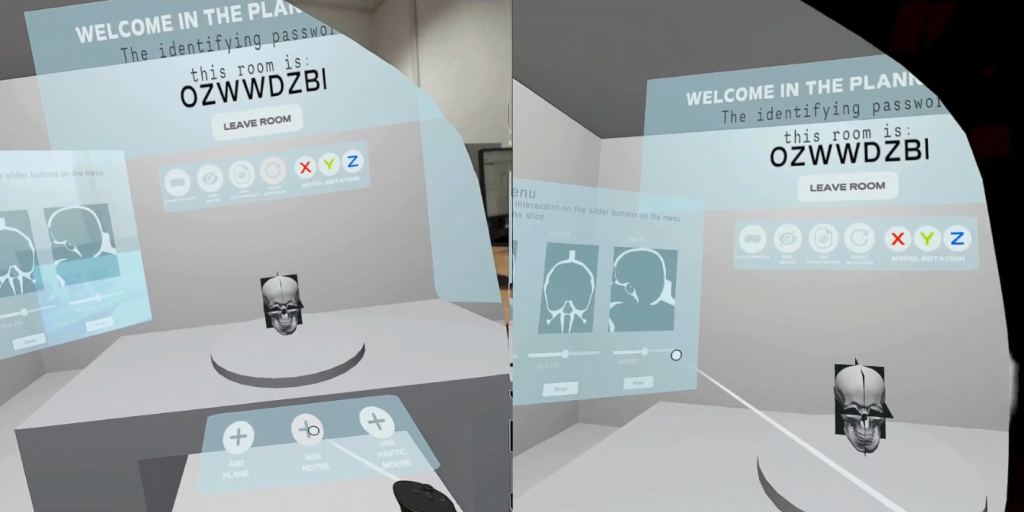
Concurrent preoperative VR planning for cranio-maxillo-facial surgery
Applications and Impact
Applications span a wide range of medical domains, including minimally invasive and robotic surgery, orthopedics, oncology, and rehabilitation. The impact is multifaceted: improving diagnostic accuracy, enhancing surgical precision, reducing variability in clinical practice, and enabling scalable healthcare solutions.
Ultimately, this area contributes to a shift toward a more proactive, personalized, and accessible healthcare system, where technology supports both clinicians and patients throughout the entire continuum of care.